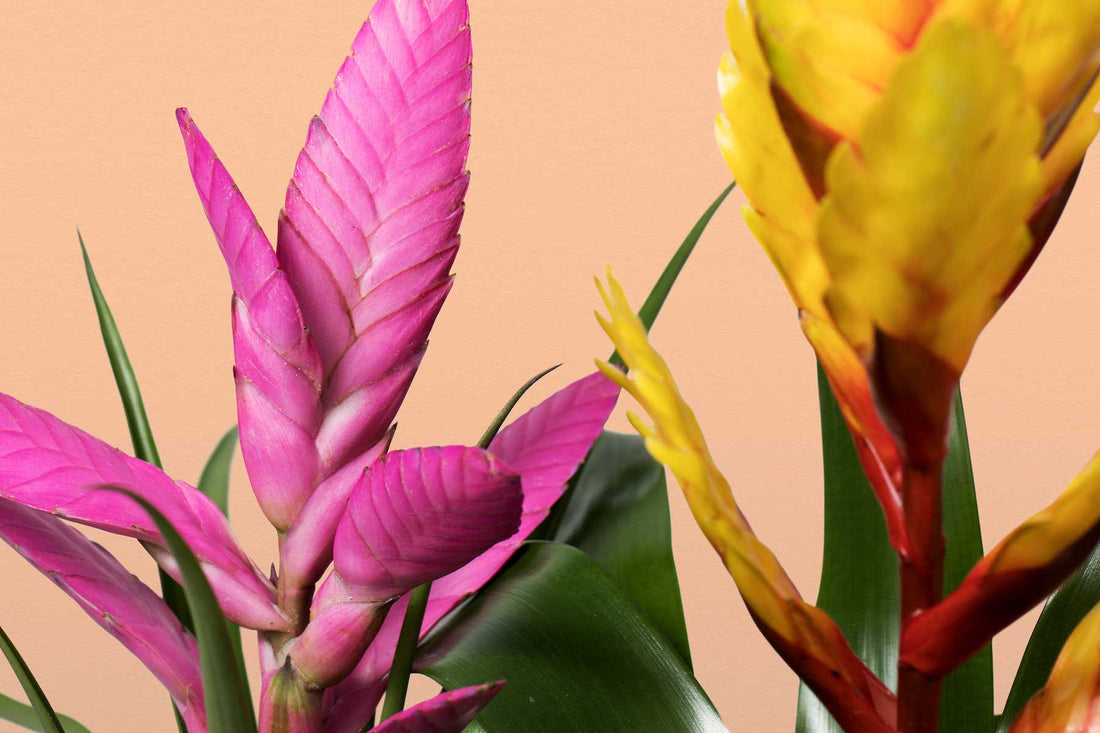
Learn how to care for Bromeliads, or plants from the Bromeliaceae family—home to thousands of colorful and eye-catching easy-care plants.
The family Bromeliaceae encompasses more than 2,500 species, and almost all of them are native to the tropical Americas—from Chile and Argentina to Brazil and the Caribbean. Some grow as far north as Virginia and one has appeared, rather improbably, in Guinea! It is believed that these plants are largely primeval; that is, they trace their ancestry to some of the earliest eras in world history. The fact that they date back 30 to 65 million years may explain how Bromeliaceae became so unusually diverse, encompassing not just unique and colorful terrestrial (ground) plants, but epiphytes (air plants) and the odd saxicole (rock plant). You may be surprised to learn that the Costa Rican flowers dart-frogs inhabit, the pineapple that you blend into your margarita, and even the Spanish moss found throughout New Orleans and Savannah are all bromeliads.
Bromeliads are part of the monocot group of flowering plants. In scientific terms, this means that their seeds contain just one leaf; they have an unusual system of thin, fibrous roots; and their leaves are “parallel veined.” In practical terms, it means that they are often able to conserve water better than many other tropical plants. All bromeliads additionally feature trichomes, hair-like growths that shield the plants from harsh sunlight and help them to absorb moisture even in dry climates. It is these and other features that make them not just some of the most colorful and distinctive houseplants—particularly those species and cultivars with pink, yellow, or purple foliage—but also one of the easiest to care for.
[product-card-1]
[product-card-2]
How much sunlight does a bromeliad need?
Bromeliads prefer bright indirect to direct light. Some, such as the spikiest varieties in the genus Neoregelia, can tolerate more direct light than others. The exact amount of direct light that a bromeliad prefers varies by species, often based on how rigid or soft its leaves are. Generally speaking, the softer and greener the bromeliad, the less light—and more water—it prefers. The more rigid and colorful the bromeliad, the more light it prefers, and the more succulent it is.
How often should you water a bromeliad?
Due to attributes like the aforementioned trichomes, many bromeliads are among the more drought-tolerant houseplants and dislike being over-watered. You can keep them healthy by watering the soil every one to two weeks in the warmer months, and every two to three weeks in the colder months. If your home is particularly warm, you might consider watering your bromeliads slightly more frequently. Also remember the above guideline about light and watering: The softer and greener the bromeliad, the less light—and more water—it prefers.
Many bromeliads have a “tank” or “cup” formed by its central rosette of leaves, and if your bromeliad is one of these “tank type” varieties, it is best to water the plant by filling its cup—this is what would happen in the rainforest. Those without a cup prefer to dry out between waterings; however, if your bromeliad does have a cup, it is actually better to keep it full most of the time.
When filling up the "tank," be very careful about the water quality. First of all, it is important to use filtered water or rainwater and if you must use hard water, it is necessary to allow it to sit out overnight. Secondly, you will want to keep the water fresh and avoid bacterial growth and salt build-up by changing the water every few days. Ideally you can pour new water into the cup, turn the cup upside-down, and then fill it with yet more water.
Do bromeliads need humidity?
Since they originate in tropical forests, bromeliads do best in somewhat humid climates (50-75% humidity), and it is recommended that you mist them once to twice a week no matter what level of humidity you experience in your home. If your home receives a lot of sunlight, however, or your bromeliad is one of the thirstier epiphyte varieties, such as a Tillandsia, you may want to mist it even more often, or consider placing by a shower or in a pebble tray. Note that if its environment is particularly humid, it will require less frequent waterings than it would if its environment were on the dry side.
Can I put my bromeliad outside?
If the climate in your city or town stays above freezing, you may be able to move your bromeliad outside year-round. If you experience a colder autumn and winter, you can still move your bromeliad outside during the late spring and summer. You will need to keep in mind the same guidelines that you would keep in mind for an indoor plant, placing your bromeliad out of direct sunlight, maximizing shade, and increasing the humidity when necessary. If you live in a dry climate, you may still wish to consider misting your bromeliad.
Are bromeliads easy houseplants?
Bromeliads are generally an easy-care plant, but there are some common problems you can look out for:
SYMPTOM: Crispy or curling edges
CAUSE: Thirsty plant, underwatered
SYMPTOM: Yellowing leaves, wet potting mix
CAUSE: Overwatered
SYMPTOM: Browning, stunted growth
CAUSE: Too much hard water. Change to filtered water.
Are bromeliads safe for pets?
All varieties of bromeliad are safe for cats and dogs, but is still a good idea to keep your cat or dog away from these plants—if they get their paws on a bromeliad, it may give them a stomach ache.