Plants 101
What To Do When You See Mushrooms in Your Soil
For millions of years, plants have been BFF’s with microbes found in soil, forming strong, intricate relationships. Plants interact with both bacteria and fungi in soil, and in fact, if it were not for fungi there would be no life on land. Here, we give you a rundown on mushrooms, fungi, and their relationship status to plants.
For millions of years, plants have been BFF’s with microbes found in soil, forming strong, intricate relationships. Plants interact with both bacteria and fungi in soil, and in fact, if it were not for fungi there would be no life on land. Here, we give you a rundown on mushrooms, fungi, and their relationship status to plants.
Fungi First
Scientists agree that fungi colonized land well before plants did. As to when they colonized land is a difficult question to answer, as our approximations are based on fossil records and can only tell us when only some organisms existed – i.e. organisms with hard or solid body parts or spores, which many fungi are anything but. Regardless of when fungi colonized land, we know they added a component to soils that was not present in soils before – large amounts of carbon. This helped to not only break down the rocks on land, but also to help retain water on land, and consequently help pave the way for plants. Thanks, fungi.
Lichen
One of the first and oldest interactions between plants and fungi is the symbiotic relationship known as a lichen. A lichen is formed from cells of algae and a filamentous fungus weaving together to form a unit that is different from either organism. The algae feeds the fungus sugars and the fungus helps to retain moisture and occasionally provide nutrients from either the substrate that they’re growing on or from dust in the air.
On the surface, this relationship seems symbiotic, which would mean both organisms can exist separately, but cooperation makes survival easier for both organisms, kind of like cohabitating with roomates. However, this is not the case for the lichen. Lichen does extend the range in which each organism can survive, but although the algae can exist and live freely, the fungus cannot.
Whether or not the fungus was able to survive in the past by itself and has lost that ability is up for debate, but either way, the relationship has evolved to be either one of commensalism or parasitism. You know, clingy.
Endophytes
Other fungi in the soil that we know are relative to plants belong to three major groups: the Basidiomycetes, the Ascomycetes, and the Oomycetes. Most endophytic fungi – that is, fungi that lives between living plant cells – are Ascomycetes, with some being Basidiomycetes. And the relationships of many endophytes to their plants are symbiotic.
Fun fact: next time you uncork a bottle of your favorite red, consider that endophytes are also responsible in part for the flavor of most wine grapes, such as the Cabernet Sauvignon.

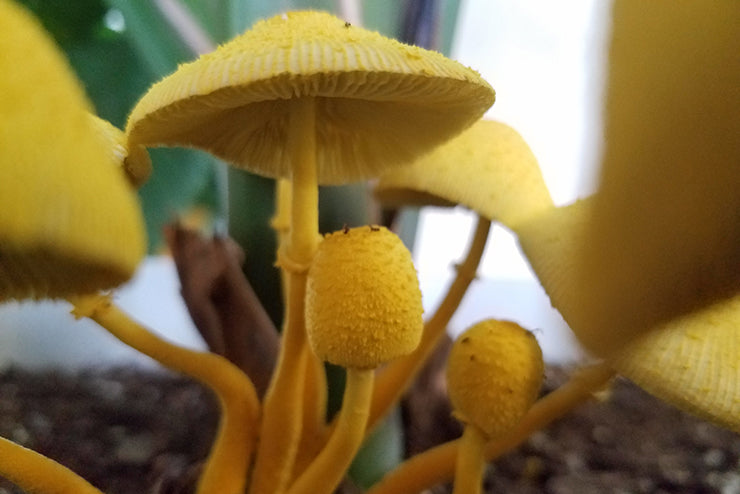
Occasionally, the fungi which live in the soil or the endophyte (or in some cases, it is the same fungus) may be in ideal conditions, and will reproduce sexually by producing a mushroom. This is perfectly normal, and is even considered to be good luck in some areas of the world.
Houseplants
We tend to think of houseplants as just the plant, but we often forget that each pot of soil is a tiny ecosystem. Microbes like bacteria and fungi live in the soil and some of them are helpful to our houseplants, while others are harmful. Most fungi in healthy soil exist to help the plant, and do so by many means.
To communicate with the plant, the fungus must connect with its roots. Through these root connections, the fungus can send and receive chemical signals to and from the plant. Some fungi will stay outside of the roots, while others may penetrate the root cells.
Regardless of which type of fungus the plant is interacting with, it accomplishes two major functions:
First – the fungus lowers the pH of the soil by selectively absorbing NH4+ (ammonium) and kicking out the H+. This helps solubilize and mobilize metals and phosphates that are essential for your plant. As a consequence of the ammonium absorption, this excess source of nitrogen also leaks into the plant. The plant trades carbon in the form of hexoses to the fungus for the phosphates and other minerals. And it just so happens that phosphate is essential for plant life.
Second – not only do fungi provide nutrients to the plant, but they also allow chemical communication amongst plants. This network of fungi has been shown to allow insect-attacked plants communication to their neighbors. It has been measured that nearby plants will boost their own innate defenses if they hear over the mycelium that one of their neighbors is being attacked – sort of like your emergency contact. Some plants use the mycelial network for more devious purposes – spreading toxins and growth suppressants so that other plants cannot grow. While others use it for more altruistic purposes like sharing sugars and nutrients to neighboring plants.

Fungi, masters of the soil, can be beneficial for your houseplants. When and if you see a mushroom in your plants soil, consider it a sign of a happy, healthy mini ecosystem. And depending where you live, a sign of good luck.
Perfect Pairings For Your Plants
-
-
-
New Arrival
-
-
-
-
Best Seller
-
-
-
Soltech Solutions
Vita Grow Light Bulb
LED grow bulb that supports the growth of your plantsFrom $85















Words By The Sill
Empowering all people to be plant people—a collection of articles from The Sill's team of plant experts across a variety of plant care topics to inspire confidence in the next generation of plant parents. Welcome to Plant Parenthood™.
Do Some Plant Shopping