How to Care for ZZ Plants
A common houseplant that’s easy to grow sounds like the perfect plant, right? The ZZ Plant may very well be the perfect plant, known for its adaptive abilities and relatively easy-going, low maintenance demeanor.
A is for Aroid
The ZZ plant is an aroid, from the family Araceae, native to eastern and southern Africa, and is spread throughout all continents except Antarctica. Aroids are some of the easiest houseplants to grow, tolerating a wide range of conditions. Aroids are common as houseplants, and in the wild, are often found growing on the forest floor, meaning they have many adaptations to surviving in many conditions, including low light. As aroids are so common, chances are, if you have a houseplant, you probably already have an aroid--Pothos, Philodendrons, Alocasias, Monsteras, ZZ plants, Aglaonemas, Arrowhead vines, Colocasias, and many more. Adding a ZZ Plant to your collection is just logical, but first, let’s get deeper into the details.
Catch Some ZZ’s
ZZ plant (Zamioculcas zamiifolia) derives its name from how it looks. “Zamio” means that it looks like a Zamia, a cycad from Central America. “Culcas” is a word derived from Arabic that generally refers to Colocasia/Alocasia. The ZZ plant is indeed related to Colocasia, and it looks like a Zamia, so Zamioculcas is a relatively accurate name. “Zamiifolia” means that the leaves are like Zamia leaves, sort of like fern meets palm tree.
In The Weeds
ZZ plants comes from East Africa, particularly Zanzibar, and inhabit dry grassland and forests in the region. The ZZ plant is an ancient relic, or perhaps an evolutionary quirk, or a mix of both. It is the only aroid that can be propagated by leaflet cuttings. This may be due in part to its native environment in Eastern Africa, where there is a wet season and a dry season. By shedding leaves in the dry season, this may be a clever way to propagate itself at a time when a lot of other plants are dying off at the beginning of the dry season. The wise ZZ takes advantage of this to proliferate. This weedy proliferation is a good trait for commercial growers to sell ZZ plants as houseplants. Most houseplants are considered weeds in their native environments. The Dutch and South Africans started cultivating ZZ plants in 1996, and it only widely became available beginning in the early 2000s. To take 4-5 years to go from a few plants to millions of plants is definitely a feat that takes advantage of this nature.
Another cool feature or the ZZ plant? Potato-like rhizomes that store water and nutrients. These rhizomes are just below the soil surface, and occasionally can be exposed. What you see above ground are leaves and the stems are the rhizomes. What you might think are stems are actually petioles or leaf stalks. To survive extremely dry seasons, the ZZ plant can die back to the tubers and completely regrow. Incredible, right? There’s more. The petioles of the ZZ plant retain some pluripotency--that is, the ability to generate a whole new plant if it is cut and planted. That makes the petioles propagatable, as though they were stems.
As if they weren’t already amazing enough, ZZ plants have been found in a NASA study to purify the air of harmful toxins. There is a rare variegated form of the ZZ plant, but so far only exists in private collections. And, did we mention, they are excellent starter plants due to their low maintenance?
GENERAL CARE
Here are a few tips approved by The Sill in caring for ZZ plants.
SUNLIGHT
Thrives in medium to low indirect light. Can tolerate bright indirect light. Not suited for intense, direct sun.
WATER
Water every 3-4 weeks, allowing soil to dry out between waterings. Increase frequency with increased light.
HUMIDITY
ZZ plants are not picky about humidity levels.
TEMPERATURE
65°F-85°F (18°C-30°C). It’s best not to let it go below 60°F (15°C).
COMMON PROBLEMS
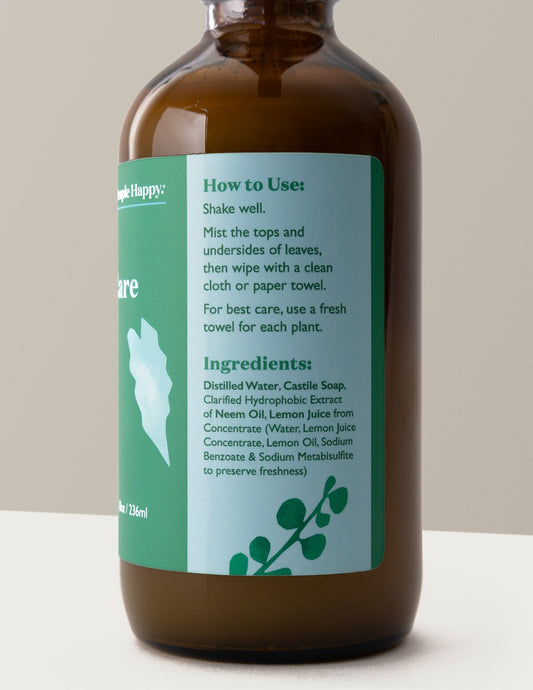
It is generally a very easy-going plant. Generally pest-free, although has been known to get mealybugs. Treat pests as soon as they appear with weekly sprays of horticultural (Neem) oil and regular wipe-downs of the plant.
SYMPTOM: Leaves turning brown and crispy at leaf edges
CAUSE: Under watered
SYMPTOM: Flopping
CAUSE: Normal for older outer leaves
SYMPTOM: Yellowing leaves
CAUSE: Rot or root disease; overwatering
SYMPTOM: Leaves curling
CAUSE: Rootbound, underwatered. Possibly cold
PRECAUTIONS
Irritating to cats, dogs, and humans only if foliage consumed. Best practice is always to keep houseplants out of reach of small children and pets.
QUESTIONS? EMAIL HELP@THESILL.COM